Upper-Crossed Syndrome: The Muscle Imbalance Behind Forward Head & Rounded Shoulders
If you spend your day at a desk or on a phone, there's a good chance your body has drifted into upper-crossed syndrome — the single most common postural pattern of modern life. It's the engine behind forward head posture and rounded shoulders, and the good news is that it's very fixable.
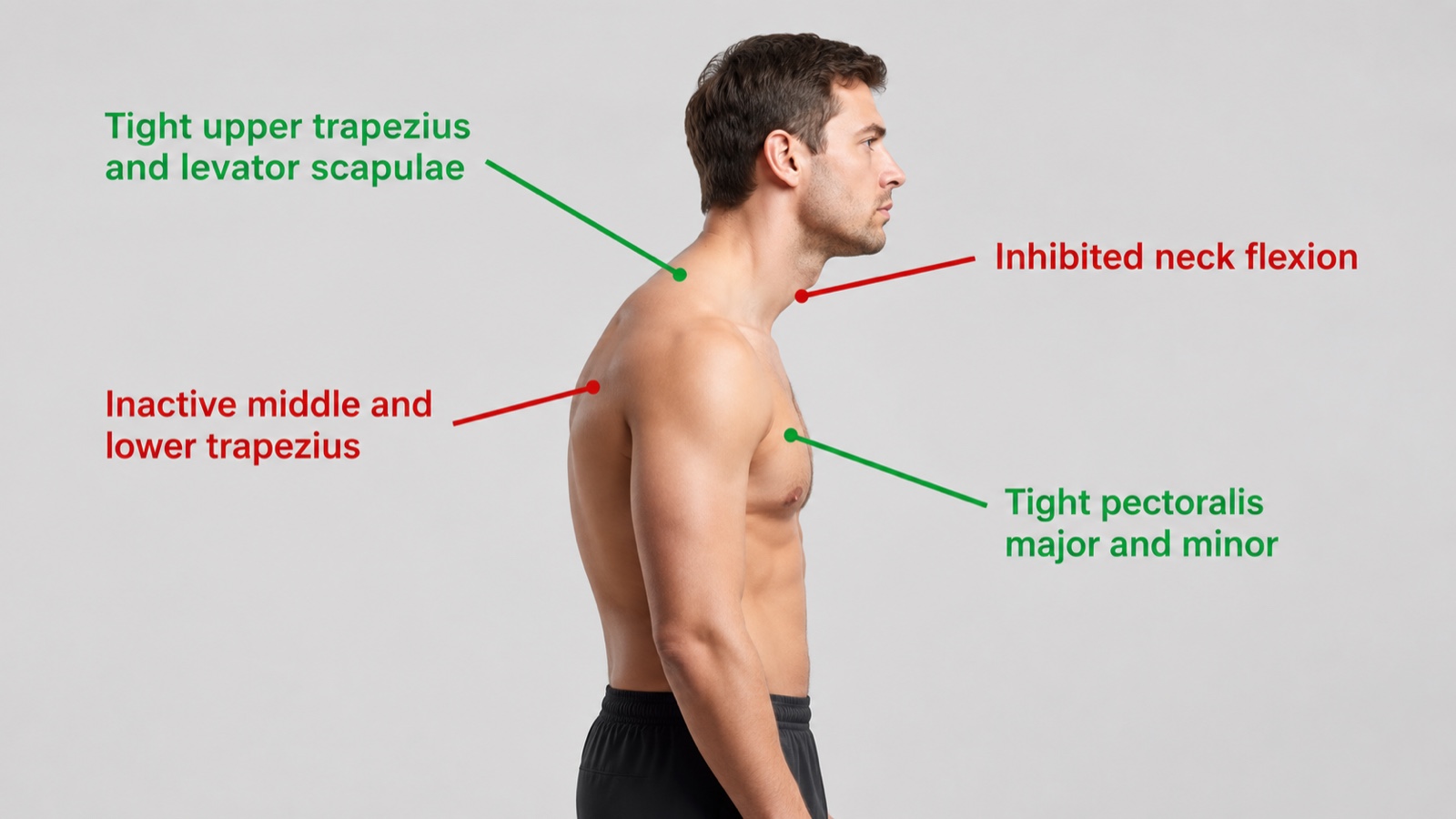
What is upper-crossed syndrome?
Described by the Czech physician Vladimir Janda, upper-crossed syndrome is a predictable pattern of muscle imbalance around the neck and shoulders. Draw an X across a side-on view of the upper body and you'll see it:
- One diagonal is tight and overactive: the upper trapezius and levator scapulae at the back of the neck, and the pectoralis major and minor across the chest.
- The other diagonal is weak and underactive: the deep cervical flexors at the front of the neck, and the lower and middle trapezius, rhomboids, and serratus anterior across the mid-back.
The tight muscles pull the head forward and the shoulders round in; the weak muscles fail to pull them back. The result is the classic "screen posture." If you want a deeper dive on either hallmark, read our guides to forward head posture and rounded shoulders.
What causes it
Upper-crossed syndrome rarely arrives overnight. It builds from hours of held positions that shorten the front of the chest and neck while the mid-back stays quiet.
- Screens and phones. Looking down at a laptop or holding a phone at chest height keeps the deep neck flexors switched off and loads the suboccipitals and upper trapezius instead. That pattern is the core of text neck and neck posture.
- Driving. A forward-leaning seat and a high steering wheel encourage the same chin-forward, shoulders-rounded shape — especially on long commutes.
- Stress and shallow breathing. When you're tense, the chest and neck often tighten first; the thoracic spine stiffens and the shoulder blades stop gliding freely.
None of this means you're "broken." It means your body adapted to what you ask it to do most often. The fix is to reverse those adaptations with targeted work and better daily setup — the same principles we outline in how to fix posture more broadly.
How to tell if you have it
Stand relaxed against a wall with heels, hips, and upper back touching it. Watch for:
- Head: the back of your head doesn't easily reach the wall, or your chin pokes forward.
- Shoulders: the backs of your hands face forward when your arms hang relaxed.
- Upper back: a visibly rounded curve at the top of the spine.
For an objective read, our posture scan measures forward-head and rounded-shoulder ratios directly from a side-on photo. You can also cross-check against the shoulder and neck condition pages if one side feels worse than the other.
The fix: stretch the tight, strengthen the weak
The corrective formula mirrors the imbalance — lengthen the overactive muscles, then strengthen the underactive ones, and carry the new position into daily habits. A balanced posture exercise routine usually covers both halves of the cross.
1. Release and stretch (the red diagonal)
- Corner pectoral stretch and lacrosse-ball pec release to open the chest.
- Upper trapezius stretch and levator scapulae stretch for the neck.
2. Activate and strengthen (the blue diagonal)
- Supine chin tuck for deep front-neck endurance.
- Floor angel, box T-spine stretch, and floor T raise for upper-back mobility and strength.
3. Re-pattern the position
Set your screen at eye level, keep your phone up, and take a posture break every 30 minutes. The exercises change what your muscles can do; your habits decide what they actually do.
Free programUpper Body Posture ResetLoosen a tight neck and chest, free a stiff upper back, and build the shoulder-blade control to sit and stand tall.See the plan →
Common mistakes
Stretching without strengthening. Opening the chest feels good, but if you never train the mid-back muscles to hold the new position, the pectorals tighten again by lunchtime.
Aggressive chin tucks. A chin tuck should be a small, controlled glide — not a forceful jam of the head backward. Start with a supine chin tuck and build from there.
Ignoring the thoracic spine. Forward head and rounded shoulders often come with a stiff upper back. Box T-spine stretching and rotation work unlock the shoulder blades so the neck doesn't compensate alone.
Expecting overnight change. Muscle length and motor control shift over weeks, not days. Re-test your wall stand or scan after three to four weeks of consistent work.
Only fixing one half of the cross. Neck-only drills without chest and mid-back work — or the reverse — leave the X-pattern intact. Treat both diagonals, even if one feels tighter today.
Putting it together
A simple weekly template: mobilise the tight muscles daily, train the weak ones two to three times a week, and re-test after a month. Explore the full neck and shoulder exercise libraries to build your routine, or read about lower-crossed syndrome — its mirror image at the pelvis.
Sources
This article draws on established clinical references:
- Muscles: Testing and Function, with Posture and Pain (5th ed.) — Kendall, McCreary, Provance, Rodgers & Romani
- Assessment and Treatment of Muscle Imbalance: The Janda Approach — Page, Frank & Lardner
- Postural Correction — Jane Johnson
Wellness, not medical advice. This article is educational. If you have pain, numbness, or a medical concern, see a qualified clinician.