Neck Posture and "Text Neck": How Looking Down Wrecks Your Neck

Poor neck posture from looking down at your phone is so common it has its own nickname: text neck, also called tech neck. When your head tilts forward even a few degrees, the load on your cervical spine multiplies — and hours of scrolling can leave your neck stiff, your shoulders tight, and tension headaches creeping up from the base of your skull. The good news is that how to fix neck posture is mostly about better screen habits plus a short daily routine that retrains the muscles holding your head up.
What is text neck?
Text neck is not a formal medical diagnosis. It describes the neck strain and postural drift that come from sustained downward head tilt — texting, reading on a tablet, or working on a laptop that sits too low. Clinicians and movement specialists often describe the same pattern as forward head posture: the head sits in front of the shoulders instead of stacked over them.
As Kendall and colleagues note in their postural assessment model, the head is heavy — roughly 10 to 12 pounds at neutral. Research on cervical loading suggests that as you look down, effective force on the neck can rise sharply. A 45-degree tilt can feel like carrying far more weight than your spine was designed to hold for hours at a time.
| Head angle (approx.) | What it feels like for your neck |
|---|---|
| Neutral (ears over shoulders) | Baseline load — your design default |
| 15° down | Noticeably more work for neck extensors |
| 30° down | Upper back and traps often join the effort |
| 45°+ down | Common "text neck" zone — fatigue and stiffness build fast |
Symptoms you might notice
You do not need every item on this list to have a neck-posture problem, but these patterns show up often:
- Stiffness at the back of the neck, especially after long screen sessions
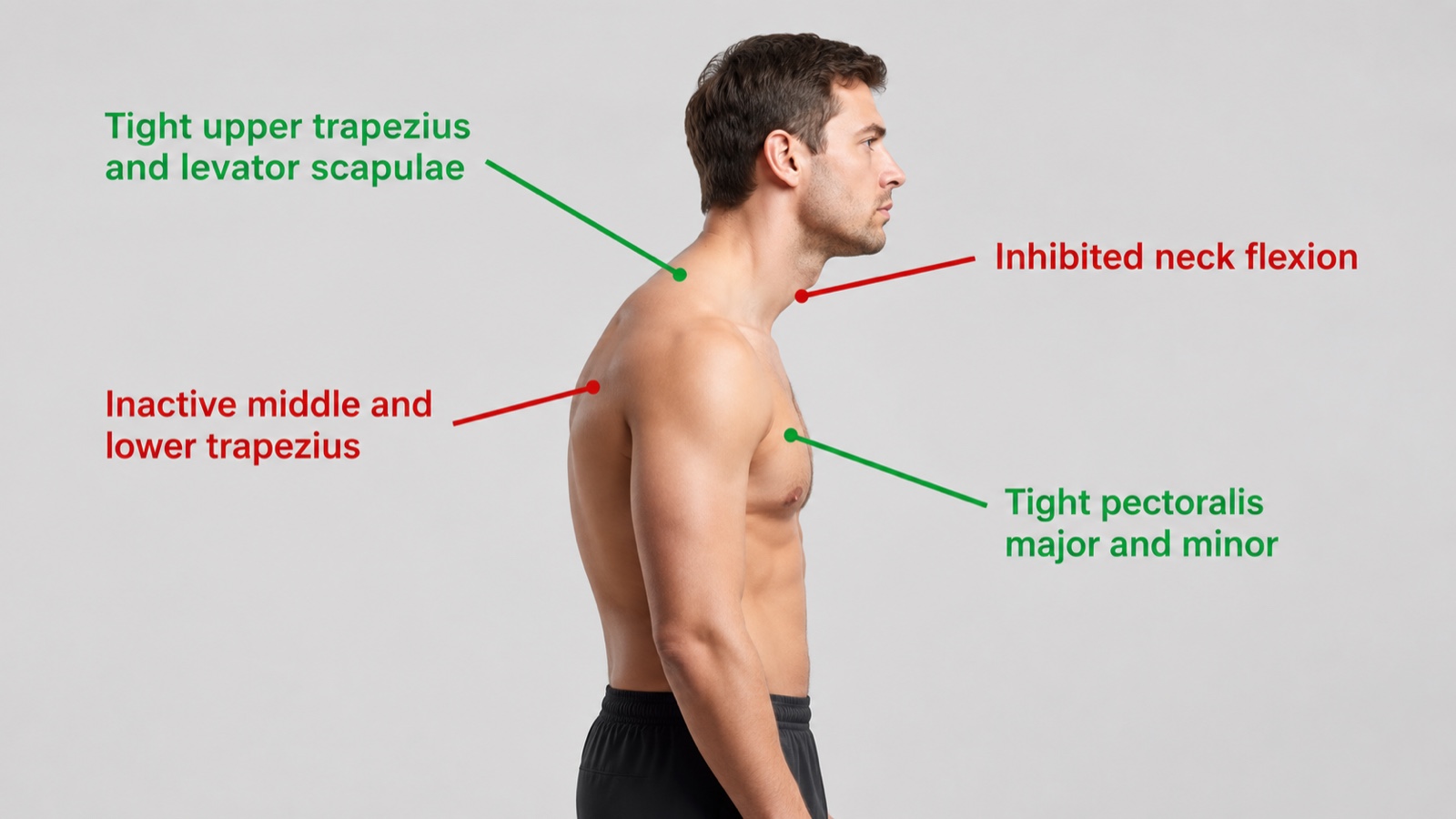
- Tight upper shoulders — the upper trapezius works overtime to support a forward head
- Tension headaches at the temples or base of the skull, sometimes linked to tight suboccipitals (the small muscles where your skull meets your neck)
- Reduced range when you try to look up or turn your head without discomfort
If headaches are frequent, severe, or come with numbness or vision changes, see a clinician — posture is one piece of a larger picture.
Why your neck posture drifts forward
Three forces usually combine:
- Screen height — phones and laptops below eye level pull your gaze down and your chin with it.
- Weak deep neck flexors — the deep neck flexors at the front of your neck should help hold your head over your shoulders; they often switch off during long sitting.
- Overactive neck extensors — the muscles at the back of your neck and upper traps tighten to fight gravity while your head hangs forward.
This pairs closely with desk habits. If you work at a computer, read our guide to desk sitting posture alongside this one. For a deeper dive into the forward-head pattern itself, see forward head posture.
How to fix neck posture: habits first
Before exercises, change the setup that created the problem:
- Raise the phone — elbows bent, device at chest to eye height, not lap height
- Lift your laptop — external keyboard if needed so the top third of the screen sits at eye level
- Movement breaks — stand, walk, or look at the horizon every 30–45 minutes; the best neck posture is your next posture
- Sleep support — pillow height that keeps your neck neutral helps recovery; poor night alignment can undo daytime work
For an objective baseline, use our posture scan — it measures forward-head ratios from a side-on photo so you can track progress over weeks.
Exercises for text neck and tech neck
A practical daily routine targets release, mobility, and retraining:
Release and stretch
- Gentle suboccipital release — light pressure at the skull base may ease tension for some people; stop if it provokes headache or dizziness
- Upper trapezius stretch — opens the side of the neck without forcing rotation
- Levator scapulae stretch — eases the back-of-neck muscle that often knots up when your head sits forward
Retrain head position
- Supine chin tuck — uses a supported nod and backward glide to build the deep neck-flexor endurance tech neck often lacks
Do these for five to ten minutes daily. Explore more options in the neck region hub — cervical retraction, neck flexor activation, and wall-standing drills all support the same goal.
 Free programUpper Body Posture ResetLoosen a tight neck and chest, free a stiff upper back, and build the shoulder-blade control to sit and stand tall.See the plan →
What to expect
Most people feel less neck fatigue within a few weeks of consistent habits plus daily mobility. Visible head position often shifts over four to eight weeks. The pattern returns quickly if you drop the screen-height fixes — exercises change what your muscles can do; ergonomics decide what they actually do all day.
Sources
This article draws on established clinical references:
- Muscles: Testing and Function, with Posture and Pain (5th ed.) — Kendall, McCreary, Provance, Rodgers & Romani
- Postural Correction — Jane Johnson
- Orthopedic Physical Assessment (7th ed.) — David J. Magee
Wellness, not medical advice. This article is educational. If you have pain, numbness, or a medical concern, see a qualified clinician.