Rounded Shoulders: Why They Happen and How to Pull Them Back

Rounded shoulders — sometimes called hunched shoulders — are one of the most visible postural shifts of desk life. Your chest collapses inward, your shoulder blades drift apart and forward, and your upper back starts to look curved even when you are standing. If you want to know how to fix rounded shoulders, the answer is not "pull your shoulders back and hold." It is a predictable muscle pattern: tight muscles at the front of the chest and weak muscles across the mid-back. Fix the imbalance and your shoulders often square themselves.
What rounded shoulders actually are
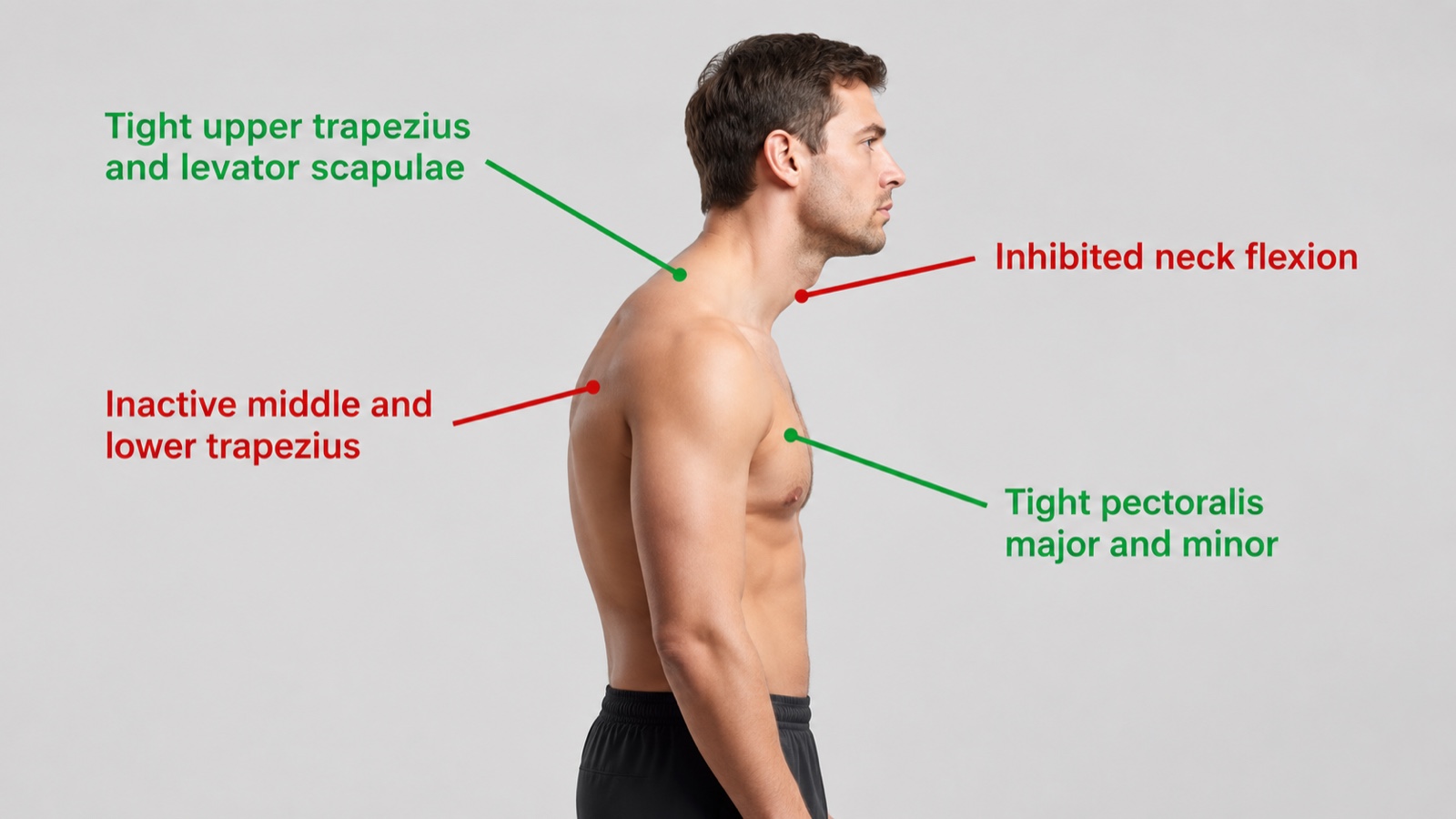
Rounded shoulders mean the shoulder girdle sits in internal rotation and protraction — the upper arm bones roll forward and the shoulder blades wing away from the spine. On a side view, the silhouette looks closed at the front and flat at the upper back.
Janda's upper-crossed model describes the engine behind this pattern: overactive pectoralis major and pectoralis minor across the chest pull the shoulders in, while underactive rhomboids, middle trapezius, lower trapezius, and serratus anterior fail to hold the shoulder blades snug against the rib cage.
| Muscle group | Typical state in rounded shoulders | Role |
|---|---|---|
| Pectorals (major & minor) | Short, tight | Pull shoulders forward and down |
| Rhomboids & mid/lower traps | Weak, inhibited | Retract and depress the scapula |
| Serratus anterior | Underactive | Controls scapular upward rotation and stability |
A simple self-test: "hands face backward"
Stand relaxed with your arms hanging at your sides — no forcing, no military posture. Look at your hands:
- Neutral shoulders: palms face your thighs or slightly inward
- Rounded shoulders: the backs of your hands face forward, or your thumbs point toward each other
You can also stand against a wall with heels, hips, and upper back touching. If the backs of your shoulders do not easily reach the wall without arching your lower back, that is another clue.
For a fuller picture of how rounded shoulders connect to a forward head and tight neck, read upper crossed syndrome and forward head posture.
Why your shoulders round in
Common contributors:
- Hours at a keyboard with arms reaching forward
- Phone and tablet use with the chest collapsed
- Lack of pulling and mid-back work in training programs heavy on push exercises
- Upper back stiffness — a stiff thoracic spine limits how far your shoulders can open even when the chest is flexible
Rounded shoulders often travel with a hunched upper back. If that describes you, pair this guide with hunchback and kyphosis for thoracic mobility work.
How to fix rounded shoulders: stretch, then strengthen
The corrective formula mirrors the imbalance — lengthen the tight, activate the weak — then practice the new position in daily life.
Step 1: Open the chest
- Corner pectoral stretch — targets the large chest muscle that internally rotates the shoulder
- Lacrosse-ball pec release — pairs light pressure with arm movement across the front of the shoulder
- Floor angel — combines shoulder mobility with controlled mid-back and shoulder-blade work
Step 2: Wake up the mid-back
- Floor Y raise — trains the lower trapezius without pulling the shoulders into a shrug
- Box T-spine stretch — restores extension through the upper back so your shoulders have room to sit back
- Floor T raise — builds middle-trapezius and rhomboid endurance for controlled shoulder-blade retraction
Step 3: Re-pattern daily habits
Set your screen at eye level, keep elbows near your sides, and take a posture reset every 30 minutes — roll the shoulders back once, then let them settle neutrally rather than holding tension.
Avoid the trap of pinching your shoulder blades together and holding all day. That creates a different kind of tension and does not retrain the muscles that should work quietly in the background. The goal is neutral — shoulders wide, chest open, arms hanging without the backs of your hands facing forward.
 Free programUpper Body Posture ResetLoosen a tight neck and chest, free a stiff upper back, and build the shoulder-blade control to sit and stand tall.See the plan →
Common mistakes when fixing rounded shoulders
- Stretching only — opening the chest feels good, but without mid-back activation the shoulders roll forward again within minutes
- Over-shrugging — pulling shoulders up and back uses the upper trapezius, not the lower trapezius and rhomboids you need
- Ignoring the thoracic spine — if the upper back cannot extend, no amount of chest stretching lets your shoulders sit back comfortably
Building your routine
Mobilize the chest daily (five to ten minutes). Train scapular control two to three times per week. Most people notice less chest tightness within two to three weeks and visible shoulder position change within four to eight weeks with consistent work.
Browse the full shoulder region hub and thoracic region hub for additional stretches and strengthening options. Exercises change capacity; your desk setup and movement breaks decide whether rounded shoulders stay gone.
Sources
This article draws on established clinical references:
- Muscles: Testing and Function, with Posture and Pain (5th ed.) — Kendall, McCreary, Provance, Rodgers & Romani
- Assessment and Treatment of Muscle Imbalance: The Janda Approach — Page, Frank & Lardner
- Postural Correction — Jane Johnson
Wellness, not medical advice. This article is educational. If you have pain, numbness, or a medical concern, see a qualified clinician.