Lower-Crossed Syndrome: Why Your Hips Tilt and Your Lower Back Aches
If your lower back aches after standing, your belly pushes forward, and your backside looks tucked under, you may be looking at lower-crossed syndrome — the pelvis-level cousin of upper-crossed syndrome. It's the muscle pattern behind the anterior pelvic tilt so many desk-bound and seated athletes develop.
What is lower-crossed syndrome?
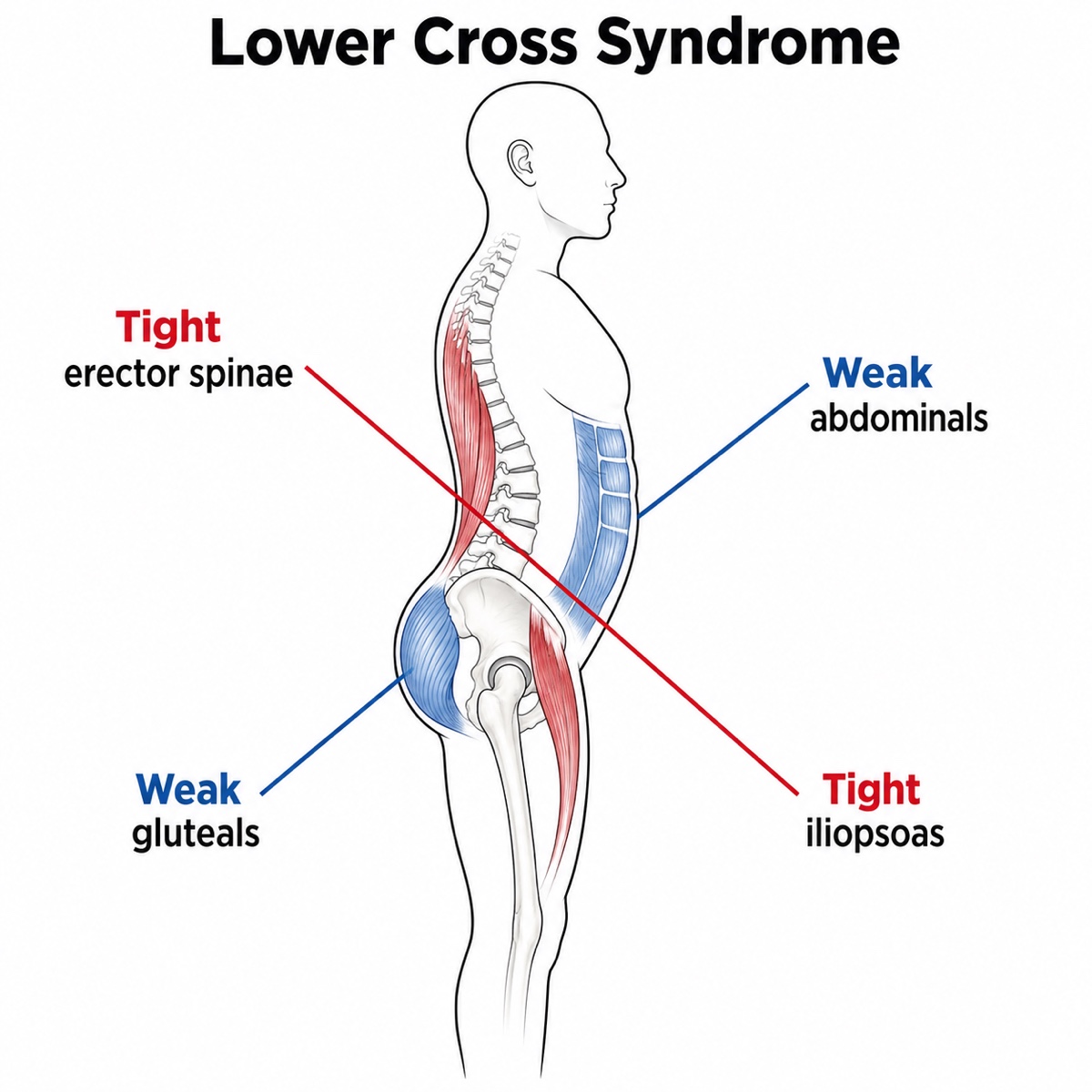
Also from Janda's work on muscle imbalance, lower-crossed syndrome is a crossing pattern around the pelvis:
- Tight and overactive: the hip flexors (iliopsoas and rectus femoris) at the front, and the lumbar erector spinae at the back.
- Weak and underactive: the deep abdominals at the front, and the gluteus maximus and medius at the back.
The tight hip flexors and back extensors tip the top of the pelvis forward (anterior tilt) while the weak abs and glutes fail to hold it level. That tilt deepens the lower-back curve and is a common contributor to nagging lumbar tension. For a focused look at the tilt itself, see our anterior pelvic tilt guide; for a related but distinct standing pattern, read about sway-back posture.
How to tell if you have it
A few simple checks at home can point you in the right direction — none of them replace a clinician if you're in pain, but they help you know what to train.
- Standing side-on, your beltline angles down at the front and your lower back looks arched.
- Lying on your back, you can slide a flat hand under your lower back with a noticeable gap.
- Prolonged standing fatigues your lower back rather than your glutes or abs.
- Thomas test (refined): lie on the edge of a bed, pull one knee to your chest, and let the other leg hang off the edge. If the hanging thigh lifts away from the bed or the knee stays bent, the hip flexors on that side are likely short — a hallmark of this pattern.
- Glute check: squeeze one glute while standing. If it's hard to feel or one side fires less than the other, the weak diagonal of the cross may be showing up.
- Standing reach test: with feet hip-width apart, raise both arms overhead without arching your lower back further. If your ribs flare and your belt line tilts forward more, your rectus abdominis may not be sharing the load — another clue the anterior tilt is winning.
A side-view posture scan will flag the forward trunk lean that often accompanies this pattern. Compare with uneven hips if one side feels more arched or tight than the other.
What keeps it going
The biggest driver is prolonged sitting — the same habit we break down in desk sitting posture. Hours with hips at 90° keep the iliopsoas shortened while the abdominals stay passive and the lumbar erectors work overtime to hold you upright. Standing with an exaggerated arch, sleeping on your stomach, and skipping hip-extension work can all reinforce the pattern. Cycling and running with a forward lean can too, if you never balance them with extension and glute work. The general correction framework in how to fix posture applies here too: lengthen what's tight, strengthen what's quiet, then practice the new position when you stand and walk.
The fix
1. Stretch the tight front and back (red)
- Kneeling runner's lunge for iliopsoas length with an upright trunk.
- Couch stretch for deeper hip-flexor and rectus-femoris length.
2. Strengthen the weak front and back (blue)
- Deep-core work: the dead bug and posterior pelvic tilt.
- Glute and hip stability: clamshells, donkey kicks, and the forearm front plank.
3. Re-pattern
If you sit most of the day, your hip flexors are held short for hours — break up sitting, stand tall, and brace your core gently when you stand. Browse the hip and core libraries to assemble a routine.
How long it takes
Most people notice easier standing and less lumbar fatigue within two to four weeks of daily hip-flexor mobility plus two to three weekly strength sessions. Visible change in pelvic angle on a photo often takes six to twelve weeks, because you're retraining both tissue length and how your brain organises standing.
Consistency beats intensity: ten minutes of targeted work most days usually outperforms one long weekend session. Pair stretching with a clear glute and deep-abdominal cue — "ribs down, glutes on" when you stand — so the new range has a job to do. Re-test with a side photo or posture scan every month and adjust if one side lags; asymmetry is common and worth addressing early rather than pushing through it.
A note on the front split
Tight hip flexors are also one of the two big front-split limiters. If a deeper split is your goal, the same hip-flexor work does double duty.
Sources
This article draws on established clinical references:
- Muscles: Testing and Function, with Posture and Pain (5th ed.) — Kendall, McCreary, Provance, Rodgers & Romani
- Assessment and Treatment of Muscle Imbalance: The Janda Approach — Page, Frank & Lardner
- Postural Correction — Jane Johnson
Wellness, not medical advice. Persistent or severe lower-back pain deserves a clinician's assessment.