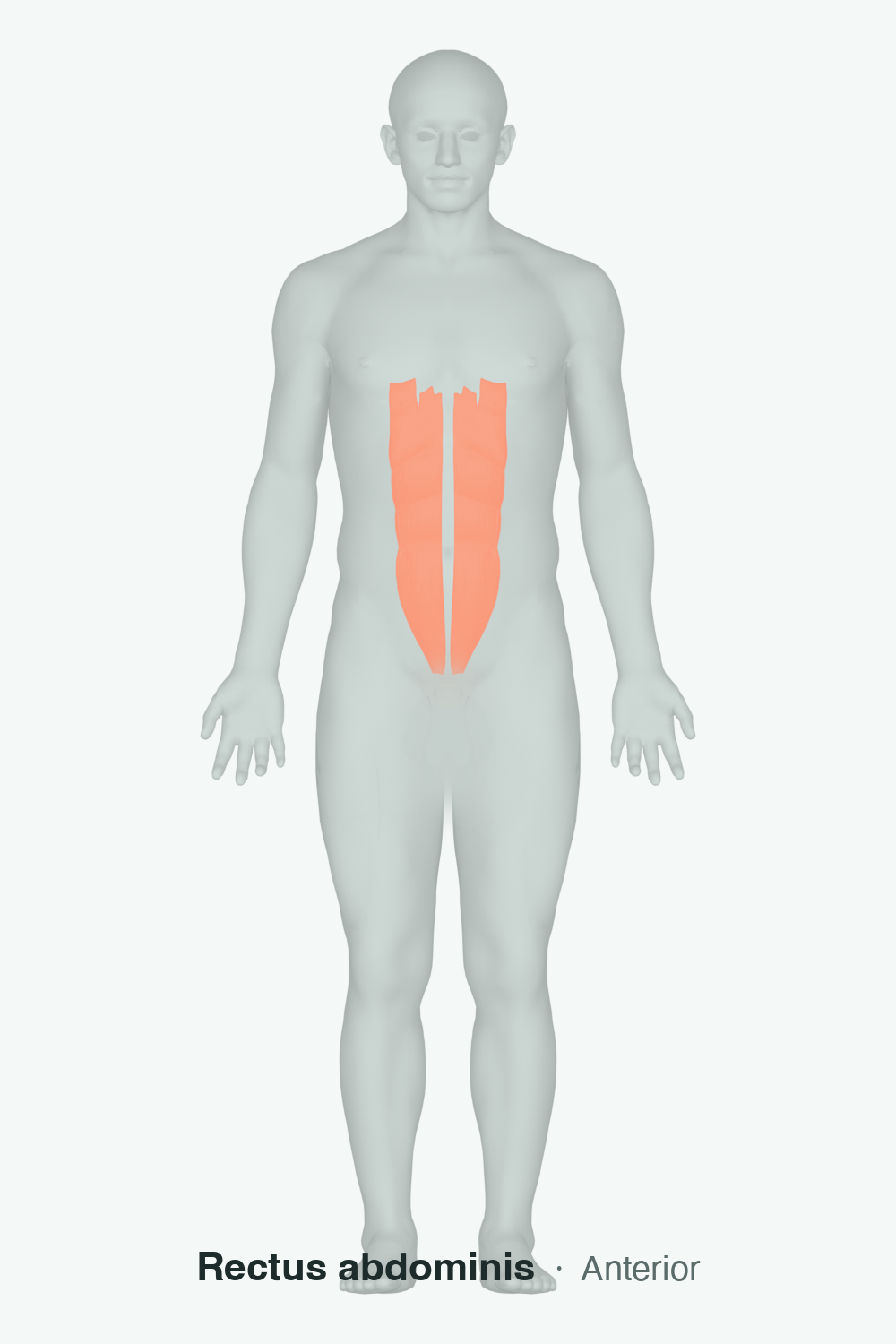
Abdominals
Exercises that target the abdominals, grouped by whether they stretch or strengthen it.
The abdominals are a group of muscles across the front and sides of the trunk: rectus abdominis, internal and external obliques, and transversus abdominis. They flex and rotate the trunk, resist unwanted motion, help manage pressure during breathing and lifting, and work with the back and hip muscles to control the ribcage and pelvis.
Abdominal control can change how the trunk and pelvis move during an exercise, but a visible pelvic angle or low-back curve does not by itself prove abdominal weakness. Body shape, hip position, task demands, comfort, and many other muscles contribute to standing posture. The goal is useful strength and coordination, not holding the stomach braced all day.
Training can include curl-up patterns, dead bugs, planks, carries, and anti-rotation exercises. Start with a version that lets you breathe and control the trunk without pain, then progress leverage, time, or resistance. Posterior-pelvic-tilt drills can help someone learn the motion, but neutral control should remain flexible rather than rigid.
Stop or regress an exercise if breath-holding, doming, pelvic pressure, or back pain increases. Persistent symptoms, recent abdominal surgery, pregnancy-related concerns, or a suspected hernia need individualized guidance.