Sway-Back Posture: The Lean-Back Slump and How to Correct It
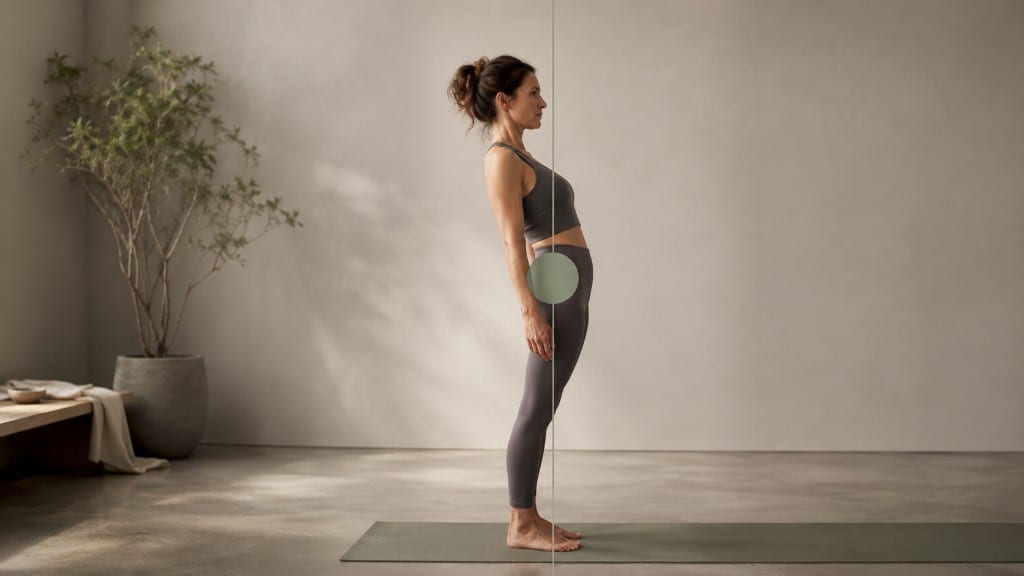
Sway back posture — sometimes written as swayback posture — is a whole-body lean where your pelvis shifts forward and your upper trunk settles back, as if you are hanging on your hip ligaments instead of stacking your joints. If you have been told you have a sway back, the fix is not simply "stand up straight." You need to learn to bring your hips back under your rib cage, rebalance the muscles that hold the pelvis, and stop relying on passive ligament tension to stay upright.
What sway-back posture looks like
From the side, a person with sway back posture often shows:
- The pelvis pushed forward of the ankle line
- The upper trunk leaning backward behind the hips
- A relatively flat or only mildly arched lower back — not the deep lumbar curve you see in anterior pelvic tilt
- Knees that may look slightly hyperextended as the body "locks out" below the hips
As Kendall describes in postural assessment, the silhouette reads as a lazy backward lean rather than an active arch. The chest may look sunken while the hips sit ahead of the rest of the body. This is different from simply standing tall with a natural lumbar curve.
Sway back vs anterior pelvic tilt (and lower-crossed syndrome)
These two patterns get confused because both involve the pelvis and lower back — but they move in opposite directions.
| Feature | Sway-back posture | Anterior pelvic tilt (APT) |
|---|---|---|
| Pelvis position | Shifts forward on the legs | Tips forward at the top (front down) |
| Lower back | Often flatter; less lordosis | Increased lumbar arch (lordosis) |
| Typical look | Hips ahead, chest back, "hanging" | Belly and backside appear prominent |
| Muscle pattern | Tight hamstrings + upper abs; weak hip flexors + lower abs | Tight hip flexors + lumbar extensors; weak abs + glutes |
Anterior pelvic tilt is the visible sign of lower-crossed syndrome — hip flexors and erector spinae dominate while abdominals and glutes underwork. Sway back is a different compensation: the body shifts the pelvis forward and leans the trunk back to reduce load on tired hip flexors and lower abdominals. Read both guides if you are unsure which pattern fits you.
How to spot sway-back posture
Side view is essential. Stand relaxed and have someone photograph you from the side, or use our posture scan for measured trunk alignment. Look for whether your hip joint sits clearly in front of your ankle and whether your shoulders hang behind your hips.
You may also notice trunk lean on a scan — the upper body drifting backward relative to the pelvis. Check the pelvis region hub and hip region hub for how pelvic position relates to the rest of the chain.
Self-feel cues. Some people describe feeling "locked" in the knees, as if they are bracing backward through the legs. Others notice tightness in the backs of the thighs after standing for a long time.
Muscles involved in sway back posture
The typical imbalance in sway-back posture runs like this:
Often tight
- Hamstrings — pull the pelvis into posterior tilt at the hip and encourage the forward hip shift
- Upper abdominals — can hold the rib cage down and back
Often weak or underactive
- Iliopsoas and hip flexors — should help anchor the pelvis under the trunk
- Lower abdominals and gluteals — stabilize the pelvis from below
The core region hub ties these segments together. When hip flexors and lower abs cannot hold the pelvis in a neutral stack, the body finds sway back as a low-effort alternative.
How to fix sway-back posture
The goal is stacking — rib cage over pelvis over legs — not forcing a military arch or a backward lean.
Step 1: Learn to stack hips under the rib cage
Practise a simple wall-standing check with attention to bringing your hips back until your ear, shoulder, hip, and ankle line up. Small shifts beat big corrections. Pair this with awareness from how to fix posture for the full-chain picture.
Step 2: Strengthen lower abs and glutes
- Dead bug — trains lower abdominal control with the spine supported
- Posterior pelvic tilt — teaches pelvic control from the floor
- Clamshells — build lateral hip stability
- Donkey kicks — build trunk control with hip extension
Run strength work two to three times per week. Consistency matters more than intensity.
Step 3: Mobilise tight hamstrings
Long, stiff hamstrings are common in sway back. Use the standing elevated hamstring stretch after a brief warm-up — its contract-relax sequence often works better than forcing a static pull. Follow with light movement so the new range carries into standing.
Step 4: Retrain daily habits
- Notice when you "hang" on one hip while waiting in line
- Avoid locking the knees and leaning the chest back
- Take breaks from any single standing position — the best posture is your next posture
What to expect over time
Most people notice a cleaner side profile and less hamstring pull within four to eight weeks of daily stacking practice, regular mobility, and two to three strength sessions per week. Track progress with photos or a posture scan every few weeks rather than judging by feel alone.
Sway back posture is correctable. Once you understand that the hips belong under the rib cage — not forward of it — the exercises and habits above give you a clear path forward.
Sources
This article draws on established clinical references:
- Muscles: Testing and Function, with Posture and Pain (5th ed.) — Kendall, McCreary, Provance, Rodgers & Romani
- Postural Correction — Jane Johnson
Wellness, not medical advice. This article is educational. If you have pain, numbness, or a medical concern, see a qualified clinician.