Sleeping Posture: Best Positions for Your Neck and Back (Side, Back & Stomach)
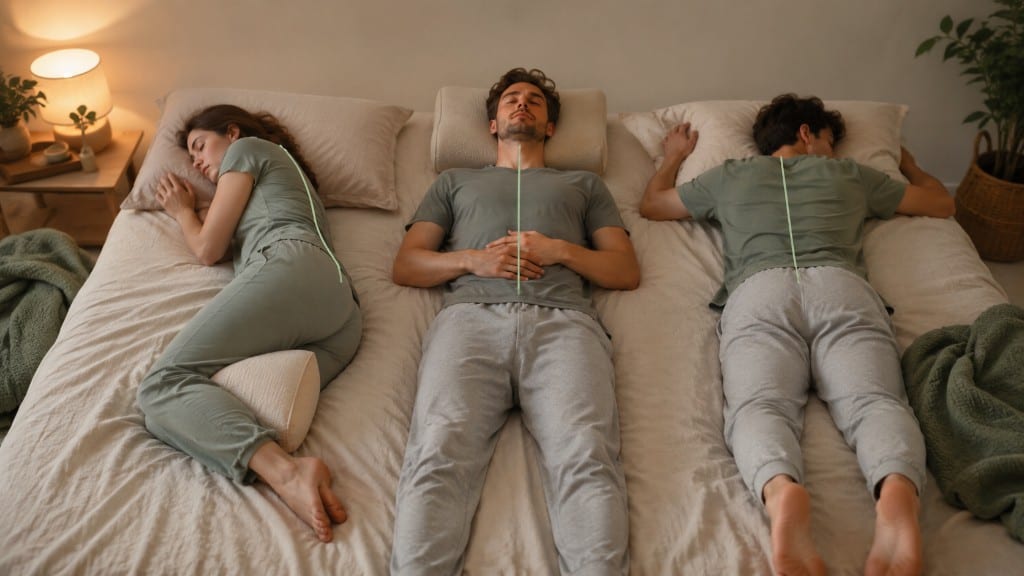
Sleeping posture shapes how your neck and spine recover — or stiffen — during the third of your life you spend in bed. Whether you are comparing the best sleeping position for your back, wondering about prone (stomach) sleeping, or trying to reduce morning neck ache, the practical question is the same: does your sleep position support neutral alignment, or does it hold your body in the same drift you fight at your desk? This guide compares side, back, and stomach sleeping without pretending one size fits everyone.
How sleep position affects your neck and spine
Your daytime posture and your sleep position for neck and back health are linked. If you sit with forward head posture all day, sleeping with a thick pillow that pushes your chin toward your chest continues that pattern overnight. If your lower back already tends toward extension, sleeping on your stomach can add more.
The spine keeps its natural curves during sleep only when pillow height, mattress support, and body position work together. Too soft or too firm a mattress, or a pillow that does not match your shoulder width, can leave you waking with stiffness even if the position itself is generally sound.
Use our posture scan for daytime baseline photos — comparing them to how you feel each morning helps you spot sleep-related patterns.
Side, back, and stomach sleeping compared
There is no single winner for everyone. This table summarises common trade-offs and setup tips:
| Position | Pros | Cons | Pillow / setup tips |
|---|---|---|---|
| Side | Keeps spine relatively neutral; good for snoring in some people | Top shoulder can roll forward; hip stack matters | Pillow fills gap ear-to-mattress; slightly thicker if shoulders are broad; pillow between knees optional |
| Back (supine) | Even weight distribution; face neutral if pillow is right | Snoring may worsen for some; low back can feel arched on firm beds | One thinner pillow under head; small roll under knees if low back feels extended |
| Stomach (prone) | Can feel comfortable short term | Hardest on neck and back for many — see below | Very thin pillow or none; often the least spine-friendly default |
Why prone (stomach) sleeping is often the toughest
Prone sleeping forces your neck into prolonged rotation — you cannot breathe face-down, so your head turns left or right for hours. That stresses sternocleidomastoid and scalenes on one side and overlaps with issues covered in text neck and neck posture.
Stomach sleeping also tends to extend the lumbar spine — the belly sinks into the mattress and the lower back arches. If you already fight anterior pelvic tilt or morning low-back tightness, prone sleep may reinforce it. Many people do sleep on their stomach comfortably; if you do, use the thinnest pillow possible and notice whether morning stiffness improves when you experiment with side or back sleeping.
Pillow height and mattress guidance
Pillow height should match your position and build:
- Side sleeping: fill the space between your ear and the mattress without lifting your head upward — your neck should stay level with your spine. Explore the neck region hub for how cervical alignment relates to pillow choice.
- Back sleeping: a thinner pillow keeps your chin from tucking toward your chest (which mimics forward head drift).
- Stomach sleeping: minimal or no pillow under the head; some people use a thin pillow under the pelvis to reduce lumbar extension.
Mattress firmness is individual. A surface that is too soft lets the hips sink and twists the spine; one that is too firm may not contour at the shoulders (side sleepers) or low back (back sleepers). Medium-firm support suits many people, but comfort and sleep quality matter — poor sleep helps no part of your posture.
The lumbar region hub explains how lower-back curve interacts with sleeping surfaces.
Morning stiffness and daytime posture
Waking stiff does not always mean you slept "wrong." It can mean:
- You held one position without movement for hours — normal for deep sleep
- Your pillow or mattress fought your body's neutral alignment
- Daytime forward head posture and desk habits left tissues already irritated before bed
A useful experiment: note your sleep position, pillow height, and morning symptoms for one week. Change one variable at a time — thinner pillow, knee pillow between legs for side sleeping, or trying back sleeping — and see what shifts.
Gentle morning mobility helps regardless of position:
- Upper trapezius stretch — eases overnight tension across the side of the neck and shoulder
- Posterior pelvic tilt — gently restores pelvic movement before standing
- Practise slow supine chin tucks before reaching for your phone
Practical tips without rigid rules
- Transition gradually. Stomach sleepers moving to side sleeping often do well with a body pillow for something to hug.
- Match pillow to current position — side pillow on your side, thinner pillow on your back if you switch during the night.
- Address daytime drift. Sleep setup works best alongside how to fix posture and desk sitting posture if work habits load the same tissues overnight.
- Comfort counts. Forcing a "correct" position you cannot fall asleep in helps nobody. Optimise within what you can sustain.
The best sleeping position is the one that lets you sleep well and wake without adding to the neck and back patterns you are already working on. Side and back sleeping are spine-friendly defaults for most people when pillow and mattress support align with your build — but individual comfort and sleep quality always come first.
Sources
This article draws on established clinical references:
- Postural Correction — Jane Johnson
- Orthopedic Physical Assessment (7th ed.) — David J. Magee
Wellness, not medical advice. This article is educational. If you have pain, numbness, or a medical concern, see a qualified clinician.