Terminal Knee Extension (TKE)
2 × 15 reps per side
A controlled band exercise for practicing the final part of knee straightening while keeping the foot grounded.
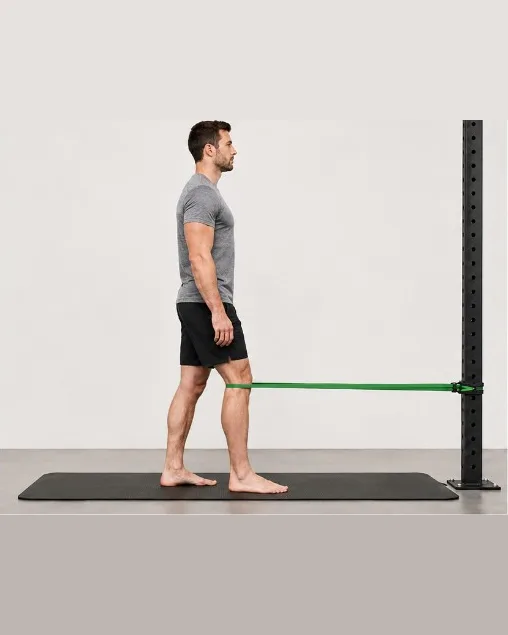
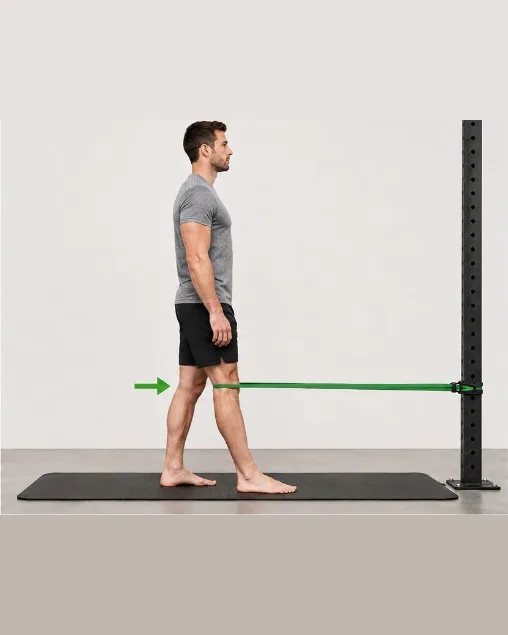
How to do it
- Inspect a light band and secure it to a stable anchor in front before looping it behind the working knee.
- Stand tall with a slight bend in the working knee, foot flat.
- Let the other leg support balance.
- Straighten the knee under control without forcing hyperextension.
- Keep the whole foot grounded and control the return without allowing band recoil.
Form cues
- Use controlled full extension rather than an aggressive lockout.
- Keep the heel and forefoot grounded.
- Stop for posterior-knee or kneecap pain.
- Squeeze the quadriceps at full lockout.
Why this exercise helps
Terminal extension is the final part of straightening the knee. The quadriceps produce and control this motion, while the band provides a clear backward pull to work against. Performing the drill in standing also asks you to keep the foot grounded and control the return instead of letting the band snap the knee forward. It can be a useful low-load strengthening option when comfortable, but it does not isolate one part of the quadriceps or diagnose why knee extension may feel limited.
Stop or modify if
- Using a band that is too heavy, causing the knee to snap into extension under band recoil rather than completing a controlled, active quadriceps-driven straightening.
- Allowing the heel to lift as the knee straightens. Keep the whole foot grounded throughout; if the heel rises, reduce band resistance or shorten the range.
- Standing too far from the anchor so the band pulls the knee forward at an oblique angle. Position the body so the band pulls straight back, roughly parallel to the floor.
Modifications and progressions
- Hold a wall or stable surface for balance so foot and knee alignment can be the full focus rather than compensating for instability on one leg.
- Begin with a very light band and limit the range to the last 10–15° before full extension before working through a fuller terminal range.
- If single-leg standing is not yet comfortable, a seated version with the band attached below knee height can approximate a similar terminal-extension pattern while seated.
Muscles worked
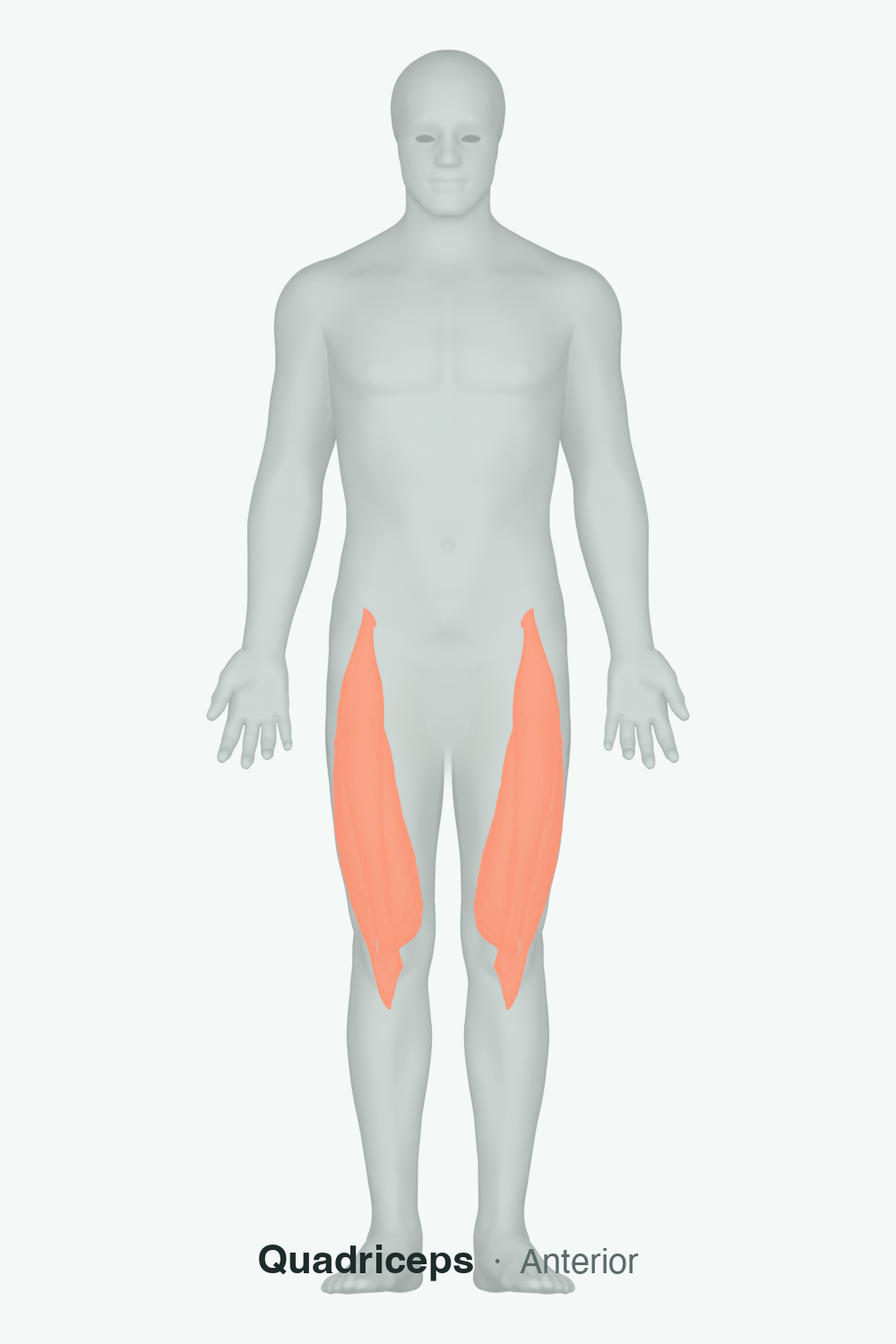
Strengthens: quadriceps
Part of a program
Part of Front Splits
This exercise is one move. Front Splits puts it in a plan — so you know what to do, in what order, and how much, week by week.
- Sequenced & dosed — the right exercises, in the right order, at the right volume.
- Progresses with you — difficulty ramps as you get stronger, not on a fixed calendar.
- Personalized — built around the specific limiter actually holding you back.
- Tracks your progress — see what's working and adjust over time.
Free · a quick assessment finds your starting point
Related exercises
Frequently asked questions
What is a terminal knee extension and why is it prescribed?
Terminal knee extension trains the quadriceps through the final part of straightening the knee under light band resistance. It offers a controlled way to practice knee extension in standing. It is not a treatment for a specific diagnosis, and a painful or mechanically blocked knee needs assessment.
Where should the band be placed and how should I stand?
Loop the band behind the working knee—not over the kneecap—and anchor it in front at approximately knee height. Stand close enough that the band has mild tension with the knee slightly bent. The band should pull straight back, roughly horizontally; if it angles sharply up or down, adjust the anchor height so the pull is more level.
Where should I feel the effort during this exercise?
You should feel a mild muscular effort along the front of the thigh as the knee straightens. Light quadriceps fatigue can build across the set. Stop for painful clicking, sharp discomfort around the kneecap, pain behind the knee, or a giving-way sensation.
When should I stop and seek advice?
Stop if you feel sharp or worsening pain at or behind the kneecap, pain at the back of the knee, noticeable swelling after the session, or a giving-way sensation. These signs warrant assessment by a qualified clinician before continuing.