Banded Ankle Inversion
3 × 12 reps per side
A seated resistance-band exercise that strengthens the inward-turning ankle muscles for controlled foot and arch support.
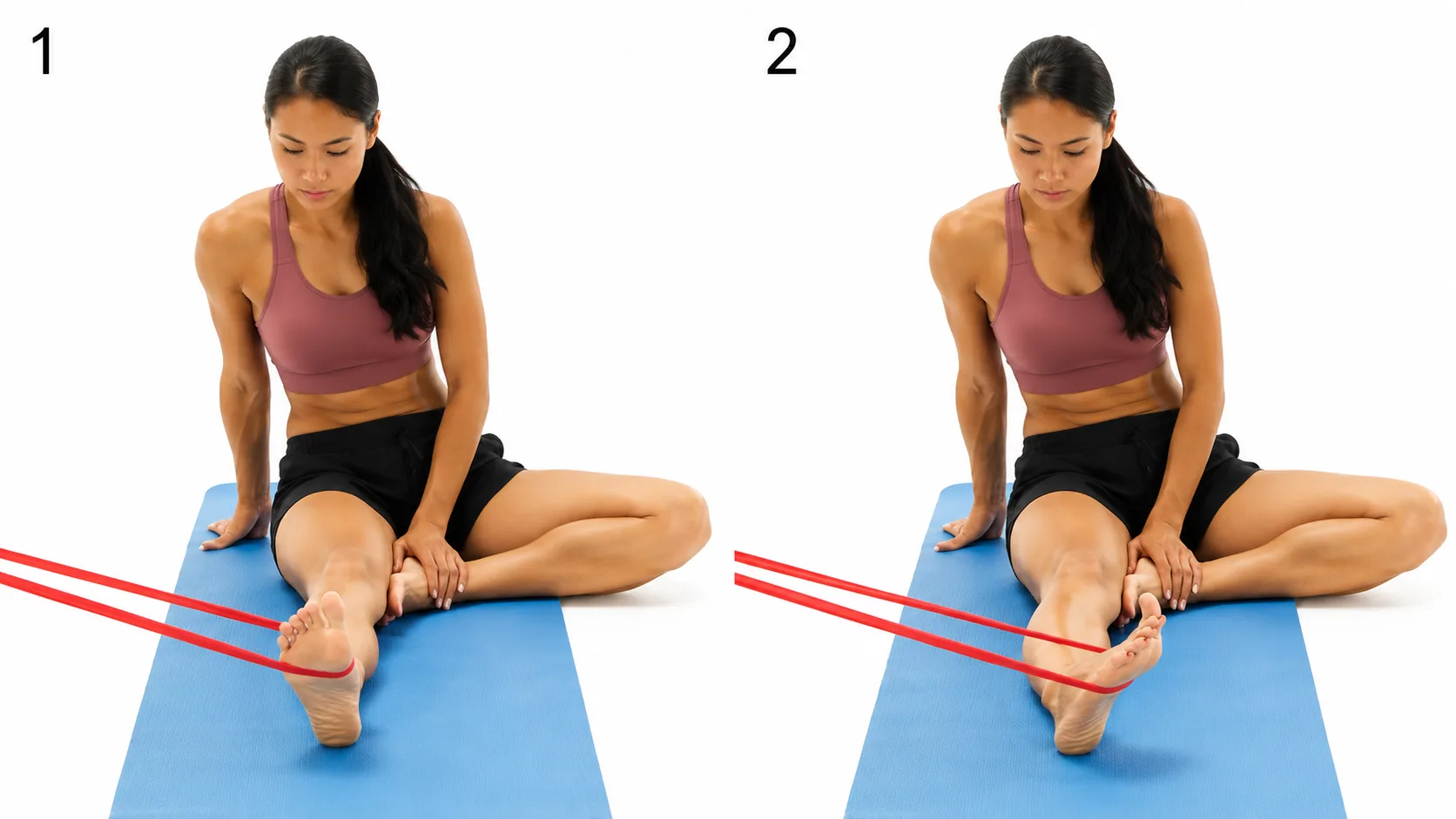
How to do it
- Sit on the floor with the working leg extended and the other leg comfortably bent.
- Loop a resistance band around the forefoot and anchor it toward the outside of the working foot so the band pulls the foot outward.
- Begin with the ankle neutral, the heel supported and the kneecap pointing upward.
- Keeping the knee and shin still, draw the big-toe side of the forefoot inward against the band without lifting the heel.
- Keep the movement relatively small without forcing the sole to face inward, then pause briefly and return slowly over 2–3 seconds before changing sides.
Form cues
- Keep the kneecap pointing up and move only at the ankle.
- Draw the big-toe side of the forefoot inward without curling the toes.
- Keep the range small; do not force the sole to face inward.
- Move inward for about 1–2 seconds and control the return over 2–3 seconds.
- Stop for sharp pain, increasing shin pain, numbness or tingling.
Why this exercise helps
The tibialis posterior is an important inverter of the foot and a key contributor to control of the medial arch, while the tibialis anterior also assists inversion and helps control the ankle. Banded ankle inversion strengthens this action through a controlled range while the knee and lower leg remain still. Building capacity in these muscles may support foot control during walking and running and can be one part of a gradual shin-splint program, but the exercise does not correct every cause of overpronation or shin pain.
Stop or modify if
- Turning the knee and hip inward instead of moving at the ankle. Keep the kneecap pointing up and the lower leg still.
- Curling the toes around the band. Keep the toes relaxed and move the forefoot as one unit.
- Rolling too far onto the outer edge of the foot. Use a comfortable range without forcing the end position.
- Letting the band pull the foot outward quickly. Control the return to the starting position.
Modifications and progressions
- Use a lighter band or practise the movement without resistance until the shin remains still.
- Work through a smaller pain-free range if the full movement causes compensation.
- Support the heel on the floor or a folded towel if holding the leg extended is uncomfortable.
Muscles worked
Strengthens: tibialis posterior, tibialis anterior
Related exercises
Frequently asked questions
Where should I feel banded ankle inversion?
You may feel effort along the inner ankle and lower leg, with some work at the front of the shin. Stop for sharp pain, increasing shin pain, numbness or tingling.
How far should I turn the foot inward?
Move only as far as you can while keeping the knee still and the toes relaxed. A small controlled range is more useful than forcing the sole to turn farther.
Will ankle inversion strengthening fix flat feet or overpronation?
It may improve the capacity of muscles that help control the arch, but foot posture is influenced by many factors. The exercise should be used as part of an appropriate program rather than as a guaranteed structural correction.