Banded Ankle Eversion
3 × 12 reps per side
A seated resistance-band exercise that strengthens the muscles along the outer lower leg for lateral ankle strength and control.
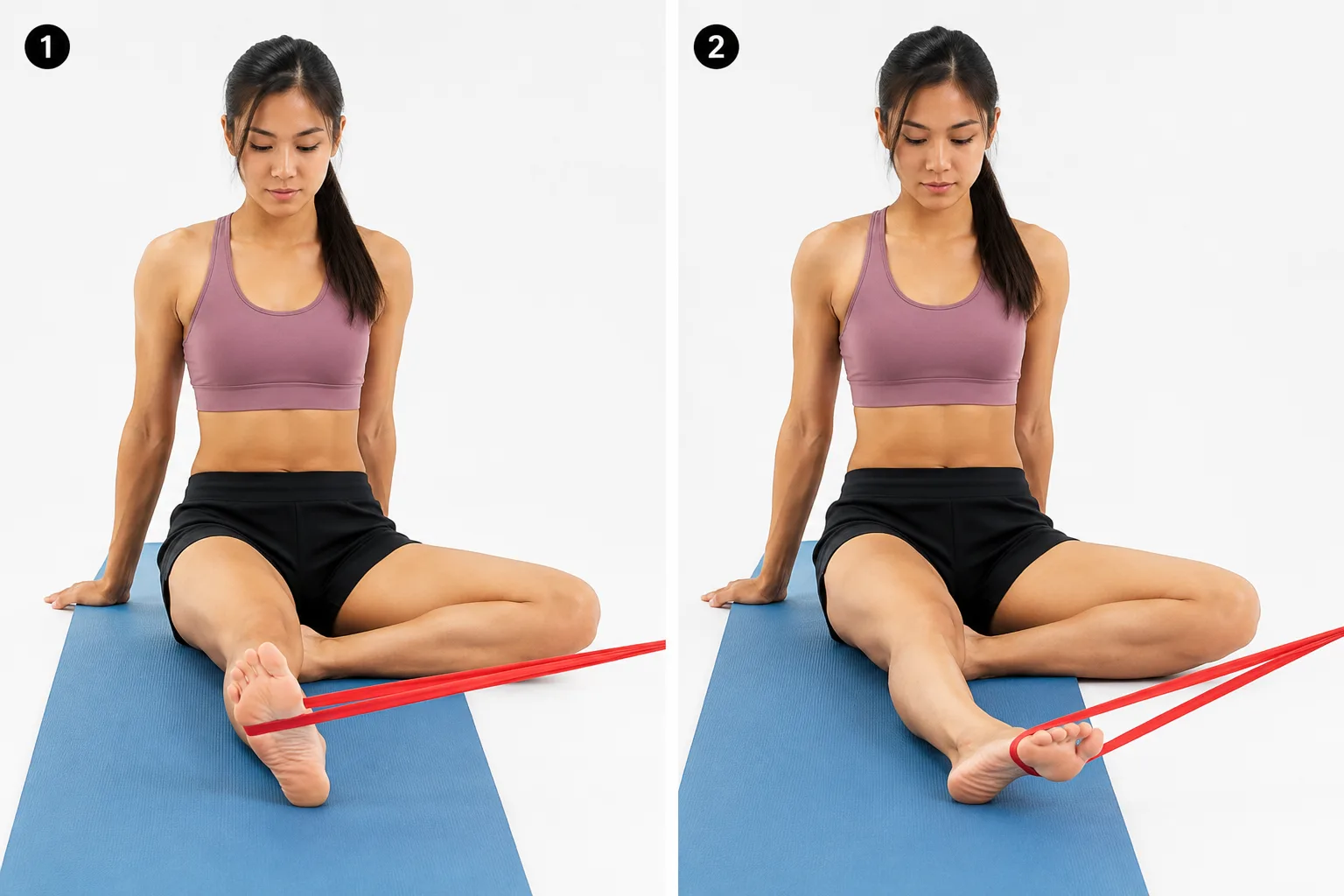
How to do it
- Sit on the floor with the working leg extended and the other leg comfortably bent.
- Loop a resistance band around the forefoot and anchor it toward the inside of the working foot so the band pulls the foot inward.
- Begin with the ankle neutral, the heel supported and the kneecap pointing upward.
- Keeping the knee and shin still, tip the sole outward so the little-toe side moves away from the anchor, without lifting the heel.
- Pause briefly, then return slowly over 2–3 seconds to the neutral position and repeat before changing sides.
Form cues
- Secure the band to a stable anchor and check it before starting.
- Keep the kneecap pointing up and move only at the ankle.
- Tip the sole outward from the little-toe side rather than curling the toes.
- Move outward for about 1–2 seconds and return slowly over 2–3 seconds; do not let the band pull the foot back.
- Stop for sharp pain, increasing shin pain, numbness or tingling.
Why this exercise helps
The muscles along the outer lower leg evert the foot and help steady the ankle during walking, running and changes of direction. Banded ankle eversion strengthens this action through a controlled range while the knee and lower leg remain still. Improving the capacity of these ankle stabilizers may support foot control and can be one part of a gradual shin-splint or ankle-rehabilitation program, but it does not address every cause of shin or ankle pain.
Stop or modify if
- Turning the entire leg outward instead of moving at the ankle. Keep the kneecap pointing up and the lower leg still.
- Pulling with the toes rather than the ankle. Keep the toes relaxed and move the whole forefoot outward.
- Letting the band snap the foot back to the start. Return slowly and maintain tension in the band.
- Using resistance that forces a small, jerky range. Choose a lighter band and move smoothly.
Modifications and progressions
- Use a lighter band or begin without resistance to learn the movement while keeping the knee still.
- Shorten the range if moving farther causes the foot to twist or produces discomfort.
- Sit in a chair with the heel supported on the floor if holding the leg extended is uncomfortable.
Muscles worked
Strengthens: ankle stabilizers
Related exercises
Frequently asked questions
Where should I feel banded ankle eversion?
You should feel muscular effort along the outer ankle and lower leg. Stop for sharp pain, increasing shin pain, numbness or tingling.
Should my whole leg move during ankle eversion?
No. Keep the knee and shin still while the forefoot moves outward at the ankle. Reduce the resistance if the hip or knee starts turning.
Can this exercise treat shin splints?
It can strengthen one part of the lower-leg system and may be included in a broader, gradually progressed program. Shin pain has several possible causes, so persistent, focal or worsening pain should be assessed by a qualified clinician.